Homemade IR RTTY Receiver
November – December 2025
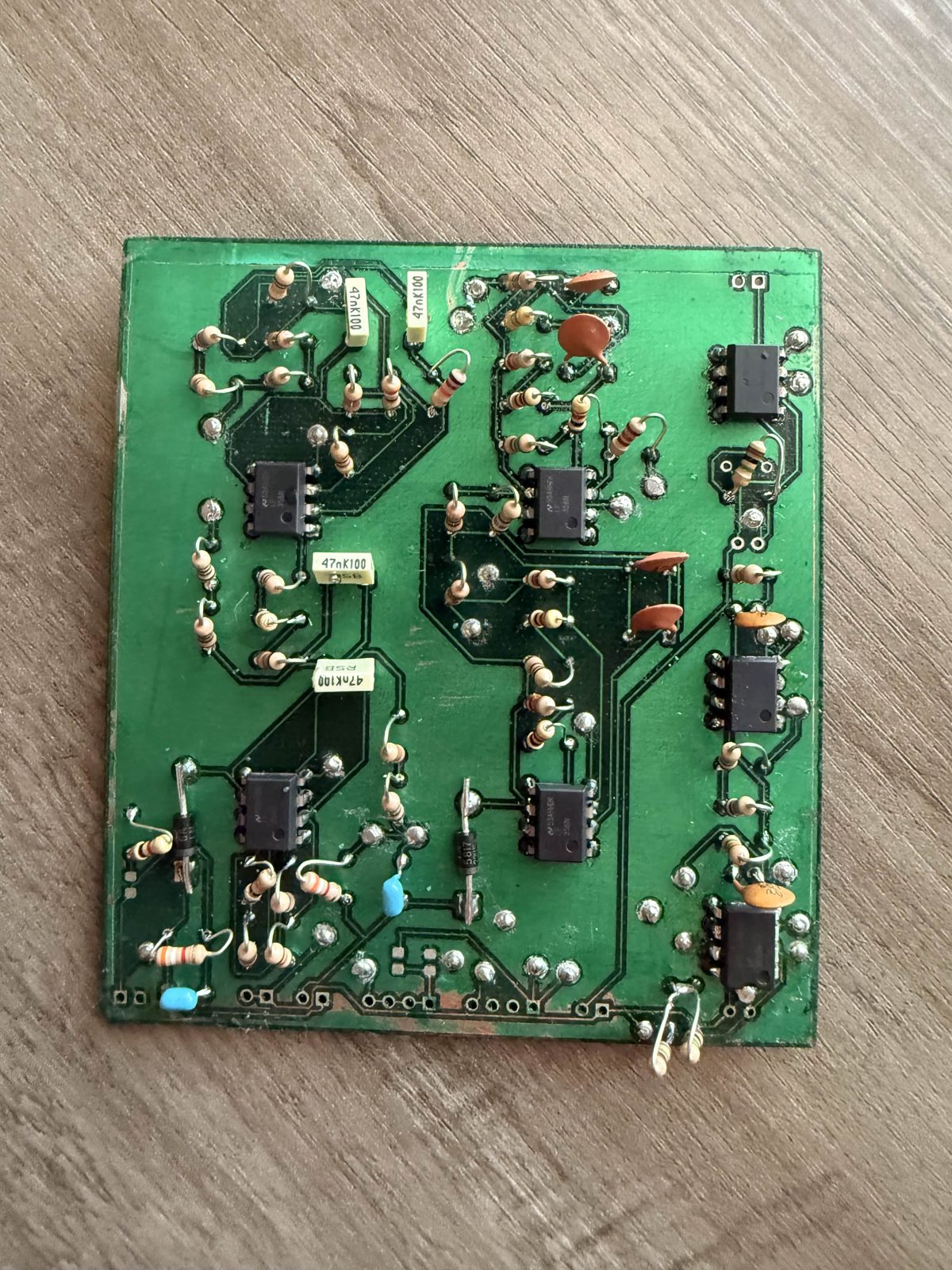
This is the analog receiver board for an RTTY project. Instead of sending FSK over radio waves, I tried doing RTTY with infrared LEDs as the medium. This board picks up the IR signal, pulls out the two FSK tones, and hands them to an Arduino that decodes the 7-bit ASCII messages being sent. I also made the PCB myself, from bare copper.
Making the board
The board started as a double-sided FR2 copper-clad blank. I used a friend's laser to ablate the copper on both sides, leaving only the traces and pads. Next I screen printed solder mask over the whole board, then ablated the mask back off the THT pads so they would take solder. FR2 blanks don't come with plated through-holes, so I used rivets as vias to tie the top and bottom layers together. Last step was populating the board.
How it works
The whole signal chain is analog until the very end, built around TI LF356N JFET-input op-amps.
- Transimpedance front end. The IR receiver outputs a current proportional to the light hitting it, so the first stage is a TIA that converts that photocurrent into a voltage.
- Gain and filtering. Two amplification stages bring the signal up to a usable level. High-pass filtering strips off DC and slow drift, and low-pass filtering cuts high-frequency noise.
- Tone separation. The amplified signal splits into two parallel bandpass filters, one centered at 2125 Hz (mark, a 1 bit) and one at 2295 Hz (space, a 0 bit). That's the standard 170 Hz RTTY shift, so the filters need to be selective enough to tell the two tones apart.
- Envelope detection. Each bandpass output feeds an envelope detector, which turns the tone into a DC level that goes high when that frequency is present.
- Decoding. An Arduino's onboard analog comparator compares the two envelopes to decide which bit is being sent, and the microcontroller handles the bit timing and assembles the bits into 7-bit ASCII characters.
What I learned
I learned a lot about analog design and analog front ends on this project, and honestly it just made me fall deeper in love with analog design and taming our naturally analog world. It also got me closer to fabricating my own PCBs. Great project, great experience.